You didn't sign up to be a data engineer, a data-entry clerk, and a borrowing-base analyst.
But every month, before your real work starts, you're all three. LoanWatch turns the dozens of files your systems already produce into an accurate, auditable borrowing base, so your best people stay on what actually moves the business.
The obligation stays yours. The burden doesn't have to.
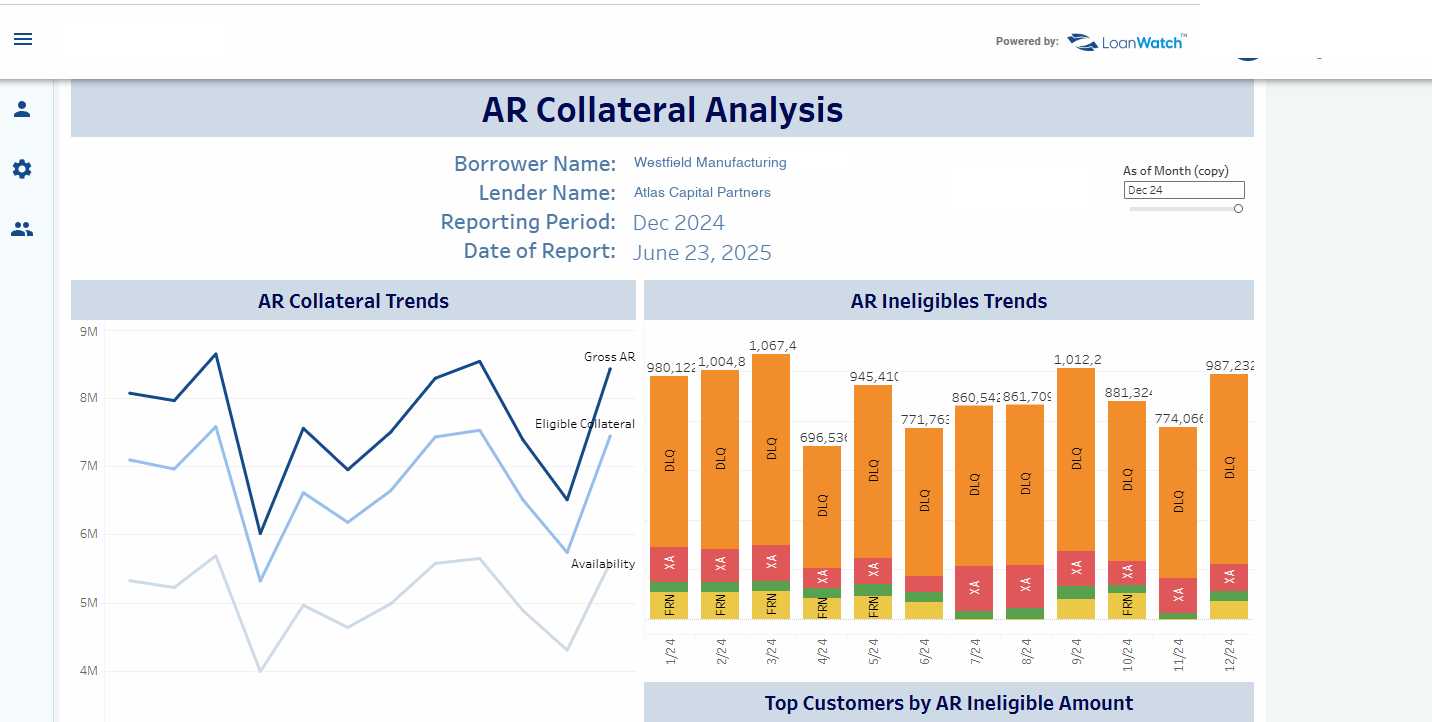
Production output. Identifying details replaced.
Three jobs nobody
signed up for.
Almost every ABL lender requires you to calculate your own borrowing base and report it every month. However you got here, it lands on your best people.
Dozens of source reports every month, each out of a different system in a different format, none of them built to calculate from. Getting them into usable data is real engineering, and it comes before a single number is computed.
Or you key it by hand: reading figures off the page and typing them into a spreadsheet, one transposition away from a wrong borrowing base.
Then the intricate part. AR and inventory ineligibles, and the base itself, calculated against the specific rules of your facility.
You've carried the facility for years, and one of your best analysts now burns up to three weeks a month servicing it. Is that really how you want to deploy your best people?
And three weeks is the generous version. Done to a standard that actually survives an exam, it may not be realistic in-house at all. It also tends to live in one person's head. If they leave, everything they know about your facility goes with them, usually right when a report is due.
Your first ABL facility. You were approved to borrow. Now, before you can draw on capital you've already been granted, you owe an accurate borrowing base by a deadline.
So your best people spend the month on loan admin, just to unlock money that's already yours to use.
An ABL facility is a real commitment. Meeting it every month shouldn't tie up your best analysts.
Your best people are valuable because they move the business forward, and the monthly borrowing base is exactly what you want off their plate. If it's your first facility and that workbook looks daunting the first time it lands, that is fine. It's a solved problem, and solving it is what we do.
Field exams are a point in time.
Your borrowing base isn't.
A field exam is a point-in-time review, run roughly once a year. Your monthly borrowing base is a different job entirely: ongoing collateral monitoring, which your lender requires every month as a condition of lending.
You can't run a field exam every month. Wrong tool, too slow, too costly. The monthly job needs a service that produces the calculation and the accurate borrowing base your lender expects. That is LoanWatch. We take the monthly job off your plate, and your annual field exam stays exactly where it is.
From your files to a number
that holds up.
Two engines do by machine what you do by hand today. LoanWatch Document Intelligence reads and reconciles your files. LoanWatch Collateral Intelligence runs the ineligibles and the base against your facility's rules. All three jobs, gone.
Document Intelligence reads your files
Send the aging reports, inventory schedules, and financial statements in whatever format your systems produce. Document Intelligence reads them, extracts the numbers, and reconciles every figure to source totals. That is a $0.00 variance before anything moves downstream. Jobs one and two disappear.
Collateral Intelligence runs your borrowing base
Clean, structured data flows into the calculation engine, where the ineligibles and the base are computed against your loan’s actual rules: cross-age logic, concentration limits, eligibility cascades, the overrides written into your facility. Job three disappears.
You get an accurate borrowing base to share with your lender
The audit trail is already assembled: the reconciliation is done, the checks are logged, and the number is ready to defend. Delivered on your monthly cadence, ready to report.
You could build the model.
But will it withstand scrutiny?
Plenty of borrowers run their base in Excel. It works until it doesn't, and the ways it fails tend to surface at the worst possible moment.
The formula is the easy part. The hard part is getting dozens of messy source files into anything a spreadsheet can even start from, and that repeats every single month.
When someone asks how a number was reached, a chain of linked cells is not an answer. And if the analyst who built the model leaves, the borrowing base leaves with them.
Cross-age logic, concentration limits, eligibility cascades, facility-specific overrides. A complex business has to get all of it right, every month, or the number is wrong.
Your borrowing base has
one right answer.
So we compute it with deterministic code and auditable configuration: the same inputs return the same number, every time. A borrowing base is deterministic, not generative. AI has a narrow, supplemental, and optional role here; it never sets the number itself.
Your number comes from deterministic math, not a language model’s best guess. It can be re-run and reproduced exactly, every time. A generative tool can’t promise that.
Where AI assists at all, it only ever suggests. Every dollar of the arithmetic is deterministic, and no figure is ever set by a model.
Nothing reaches you on the machine’s word. Anything uncertain goes to a person, and the number you deliver is one a human has confirmed.
The AI is optional. The math never is.
$0.00 variance.
30+ checks. Every file.
Every number is reconciled to its source document before it moves, and more than thirty automated checks run on every file. The base is computed against the full intricacy of your facility:
A manufacturer with a large, covenant-heavy ABL facility was submitting dozens of collateral source files every month. Producing the borrowing base pulled one of their best people off the business for weeks at a time.
LoanWatch now ingests those files and calculates the ineligibles and the base against their facility's rules every month. Their best person is back on the business, and the monthly close is routine, accurate, and auditable.
Details generalized to protect the client.
Defensible for everyone
at the table.
When the field examiner arrives, the reconciliation is already done and the audit trail is already assembled. Your borrowing base is a number you can stand behind with your lender, with your auditors, with your own board. An accurate, auditable base gives you more than a lighter month. It gives you a base you can defend under scrutiny.
We work with your lender to make sure your facility's terms and reporting format are set up correctly in the app, so the borrowing base you deliver reflects your loan agreement exactly.
Let us run your next borrowing base.
Send us the files you already produce every month. We'll show you the borrowing base that comes back: reconciled to source, with the audit trail assembled. The obligation stays yours. The grind doesn't have to.
Or reach us directly at info@loanwatch.io