Borrowing bases you can trust. From the documents your borrowers already send.
LoanWatch reads your borrowers' aging reports, AP summaries, and financial statements in the formats their systems produce. Every figure is extracted and validated against source totals to a $0.00 variance.
Clean, structured data flows straight into borrowing base calculations. Run the deterministic engine yourself, or have the monitoring delivered for you as a service. The engine behind both is the same.
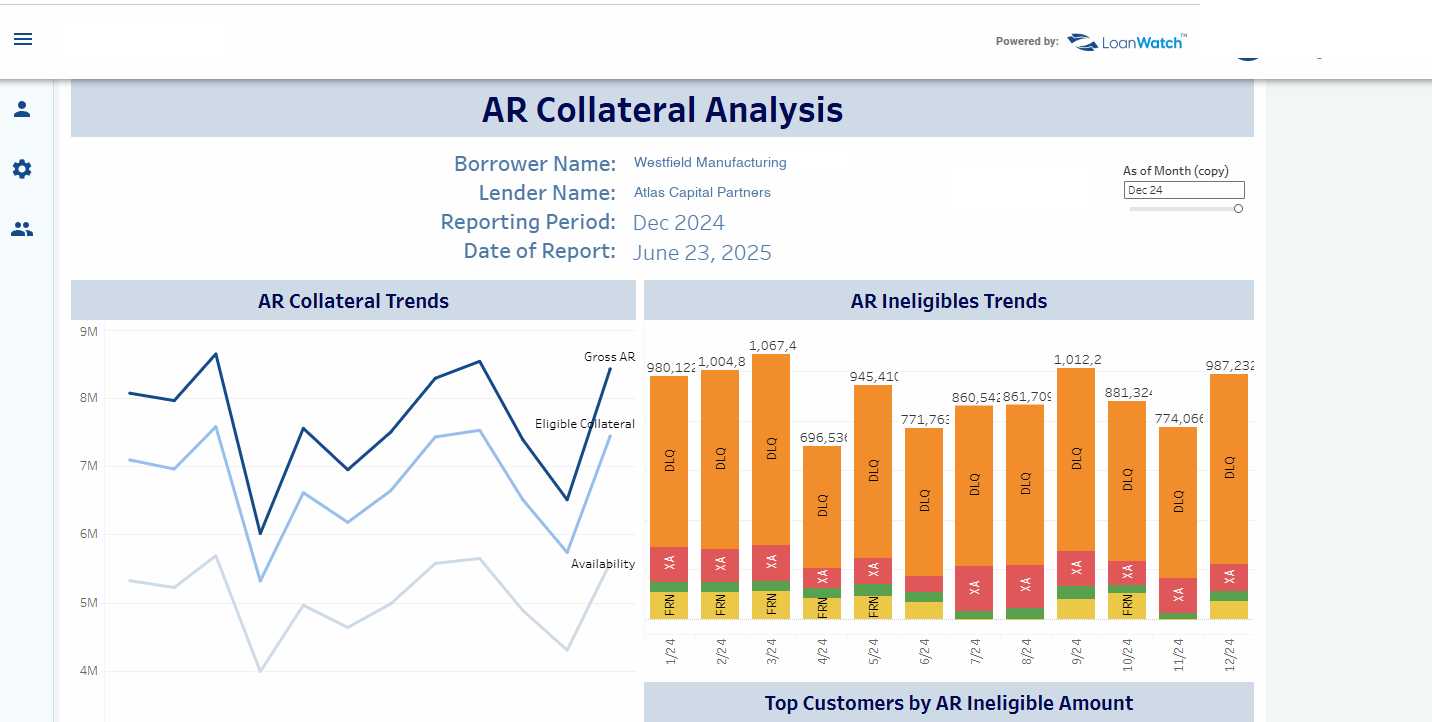
Production output. Identifying details replaced.
Where borrowing base
errors hide.
Without systematic document intelligence, you're trusting a borrower's self-reported collateral position through a chain of custody that's broken at every step. The result is a number that no one can fully audit and no one fully trusts, yet it directly governs how much capital you extend.
When a lender first ran LoanWatch against their active portfolio, they expected the system to confirm what they already knew. Instead, it flagged material discrepancies in 89% of their borrowing base calculations. Errors that had been governing advance rates for months.
Independently verified by the institution's own reconciliation team.
Your borrower submits their collateral report in January. The field examiner arrives in September. The discrepancy on page twelve? It's been governing your advance rate since February.
Borrowers use different accounting systems with different layouts and export formats. If the analyst who built the reconciliation spreadsheet leaves the company, the borrowing base leaves with them.
Trade settlement, structural engineering analysis, pharmaceutical quality control — these have been automated for decades. ABL document processing still depends on analysts manually copying numbers between screens.
One engine.
Two ways to put it to work.
LoanWatch began as software: a document-intelligence pipeline that reads what borrowers send, and a deterministic engine that turns it into a borrowing base you can defend. That same engine now powers a second route. For lenders who would rather not run anything, LoanWatch delivers collateral monitoring between field exams, working with experienced field-examination partners.
Collateral Intelligence
The rules engine handles the complexity that spreadsheets can't: cascading eligibility interactions, cross-age logic, concentration limits, and borrower-specific overrides. LoanWatch centralizes invoice-level collateral data into a structured repository for trend analysis and portfolio-level risk visibility.
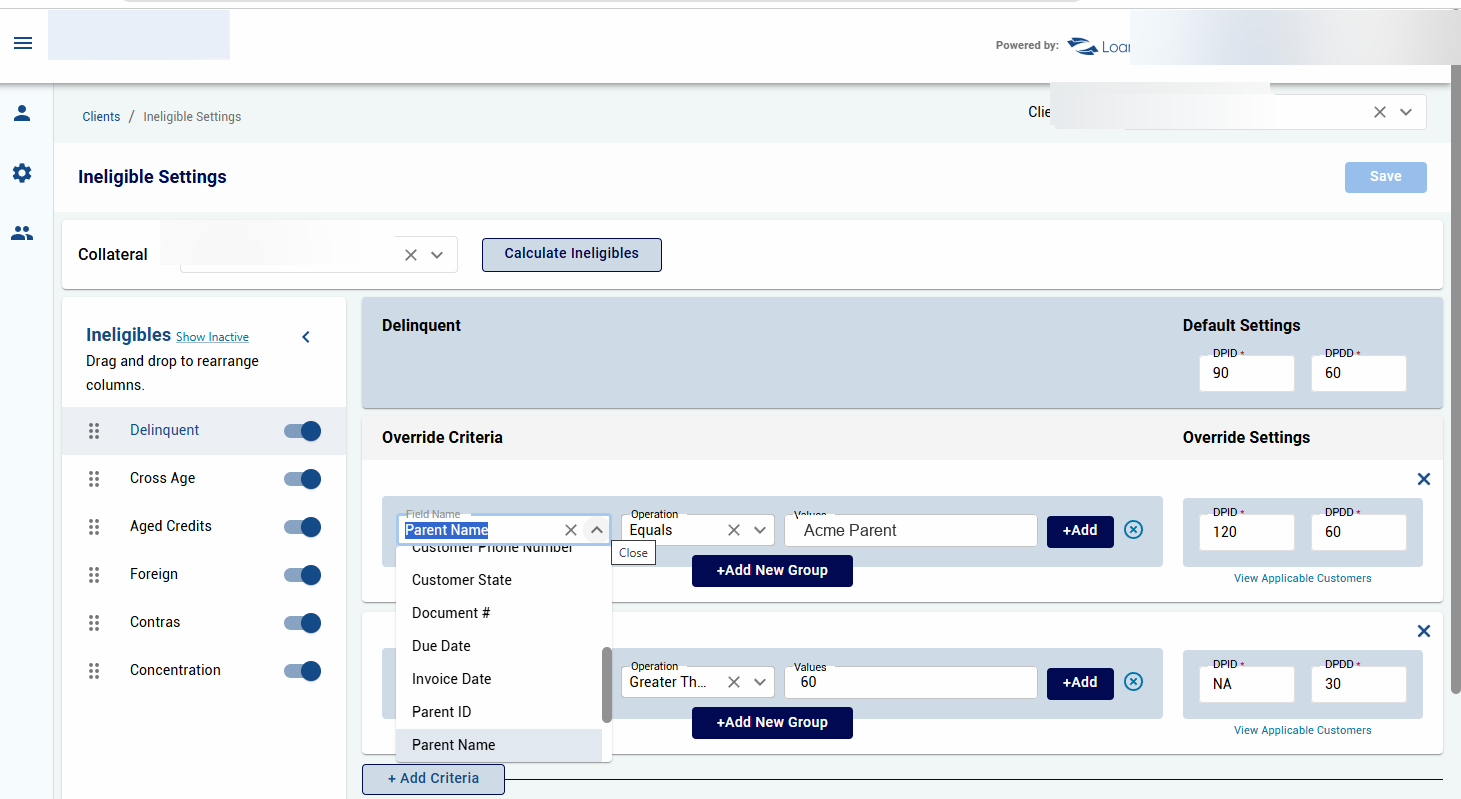
Production output. Identifying details replaced.
Document Intelligence
AI reads your borrowers' aging reports, AP summaries, inventory lists, and price books, then delivers validated, structured data. It handles whatever format and accounting system your borrowers happen to use.
27 checks run on every document. Zero exceptions.
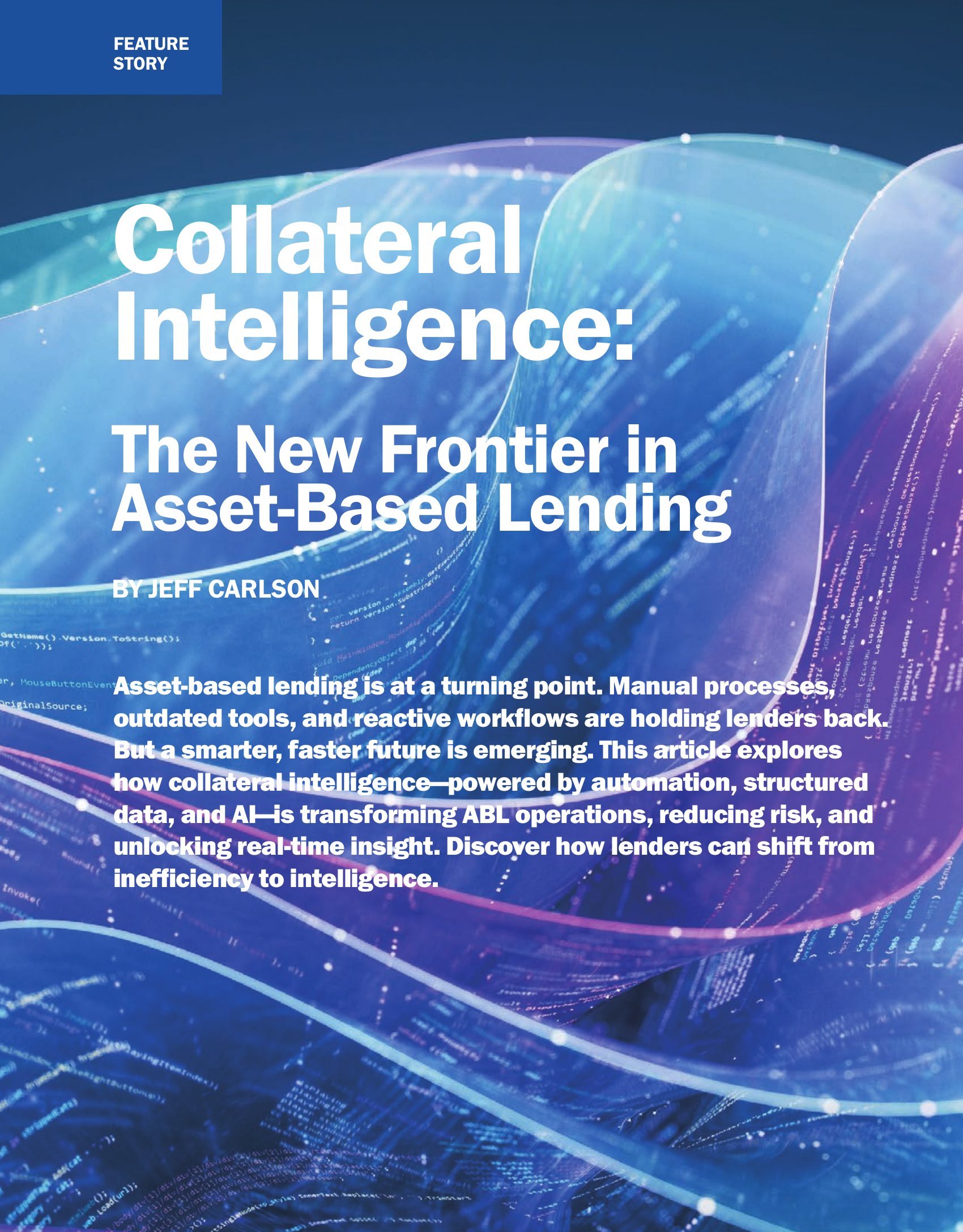
Featured in The Secured Lender
Jeff Carlson, CEO of LoanWatch, authored the feature story “Collateral Intelligence: The New Frontier in Asset-Based Lending” in the October 2025 edition of The Secured Lender, published by the Secured Finance Network.
Documents flow in. Intelligence goes to work.
QuickBooks, Dynamics GP, SAP, Sage, custom ERPs — LoanWatch reads whatever your borrowers' systems produce. No data mapping, no integration project. The document itself is the integration point.
$0.00 variance.
That's our standard.
Before any data leaves the system, it passes through a validation gate designed around a single standard: the extracted numbers must reconcile exactly with the source document. AI generates the parsing code. Deterministic validation confirms every number.
Every document processed ships with its own validation report. When your field examiners arrive, the reconciliation work is already finished and the audit trail is already assembled.
LoanWatch runs twenty-seven automated machine checks on every document processed, including:
Validation Report
Generated Feb 8, 2026
...and 21 more checks passed
LoanWatch Document Intelligence / Validation Sidecar v1.2
How a borrowing base gets built.
Raw borrower documents flow through extraction and validation into a calculated, verified borrowing base with real-time availability. Each step depends on the one before it. If extraction is wrong, validation can't save it. If validation is missing, every calculation downstream is suspect. Partial automation doesn't work here.
Documents arrive
Borrowers submit aging reports, AP summaries, inventory schedules, and financial statements in the formats their systems produce. PDF, Excel, and CSV out of QuickBooks, Dynamics GP, SAP, Sage, and the other accounting systems they run.
Intelligence reads
Document Intelligence identifies the document type, source system, and layout. The AI classifies the content, extracts structured data, and maps entities, debtors, and amounts without manual intervention.
Numbers reconcile
Every extracted value is checked against source totals to a $0.00 variance, and anything that doesn’t match is flagged immediately. Twenty-seven automated machine checks run on every document. Where a number needs a human eye, a domain reviewer confirms it before it moves downstream, so the result carries professional judgment and not only machine validation.
Borrowing base calculates
Validated data flows directly into the collateral engine, where your eligibility rules take over. Advance rates, concentrations, cross-age logic, and aging cutoffs are fully configurable. The output is a calculated borrowing base with real-time availability.
Exceptions surface
The AI handles routine document processing. Your team focuses on the exceptions that require professional judgment, working through interactive verification reports designed to make that review efficient and defensible.
System learns
Every correction refines your dedicated instance. Your data never leaves your environment. Drift detection catches emerging issues before they compound. By month twelve, the system has captured your institution's patterns and knowledge that once lived only in people's heads.
The same six steps deliver collateral monitoring as a managed service. Your borrowing bases are recalculated, reconciled, and returned to you between field exams, with no system for your team to operate.
Purpose-built for ABL.
Four distinct system layers handle document processing from intake to borrowing base. AI powers the intelligence. Deterministic code does the processing. Automated validation stands between every extracted number and your collateral decisions.
AI-powered document reading, format classification, entity resolution, and structured data extraction. Handles whatever accounting systems your borrowers use.
Multi-level rules engine for eligibility, advance rates, concentrations, cross-age logic, and sublimits, configurable at collateral, borrower, and lender level. The data precision that makes portfolio analytics possible.
Twenty-seven automated machine checks run on every document, every time. Extracted totals reconcile against source totals to $0.00 variance. Discrepancies are caught before any human touches the data.
Documents are processed by deterministic, tested code, not by AI making real-time guesses about your data. AI writes the extraction logic. Validated code runs it.
Strict data separation with per-customer encryption. Your data is never visible to other customers.
Data encrypted at rest and in transit. AI inference runs within the infrastructure boundary.
Only structural metadata reaches the intelligence layer. Column headers and format signatures. Never raw financial data.
AI is optional. The math never is.
Every number LoanWatch produces is calculated by deterministic code: the same inputs return the same result, every time. AI reads messy documents and flags exceptions for a person to judge. It never decides a borrowing base. Institutions that cannot allow third-party AI can turn it off and keep the deterministic engine, run LoanWatch inside their own cloud, or keep all inference within their own environment. The platform works either way.
AI proposes. Deterministic code executes. Automated validation confirms.
Field exams are a point in time.
Collateral isn't.
Most middle-market lenders see a borrower's collateral twice a year, when the field examiner arrives. Between those visits, the borrowing base is whatever the borrower reports.
LoanWatch closes that gap. We deliver collateral monitoring as a managed service, working with experienced field-examination partners. Every borrowing base is recalculated as it arrives, reconciled against what the borrower submitted, and returned to you with the variance and trend analysis across your portfolio. It runs on the same engine behind our software, so the numbers carry the same precision.
Validated borrowing bases on your monitoring cadence, monthly or quarterly, instead of once or twice a year when the examiner arrives.
Each borrower submission is reconciled against the recalculated borrowing base, with the differences flagged and explained.
Delivered as a managed service with experienced field-examination partners. No software for your team to operate, no headcount to add.
It fits lenders who monitor monthly or quarterly and would rather buy the outcome than build the capability. You get validated borrowing bases between exams without staffing a team or operating a system.
Hand off the borrowers who cost you the most to monitor.
Some lenders take borrowing-base production onto themselves to make life easier for their borrowers, and they absorb the risk that comes with it. You don't have to. Refer your most complex borrowers to LoanWatch, and their monthly calculation gets handled for them, to a standard that holds up. The obligation, and the risk, stay where you want them: with the borrower.
You get a clean, accurate borrowing base out of even your most demanding facilities, and you never have to run it yourself. See how we work with borrowers.
Built for the way you lend.
Asset-based lending looks different at a fast-moving private credit fund than it does inside a regional bank. LoanWatch meets each on its own terms.
“Grow the book without growing the back office.”
You are moving faster than your operations can keep up. LoanWatch gives a lean team the collateral capacity of a much larger one: borrowers set up in hours, ineligibles and borrowing bases calculated the same way every time, and the analytics to see your whole book at a glance. Run the software, or have the monitoring delivered for you.
“Precision your examiner trusts. Infrastructure your security team approves.”
You need numbers that hold up to an exam and a deployment that holds up to a vendor review. LoanWatch plugs in alongside the systems you already run, keeps your data inside your own environment, and lets you turn AI off entirely while the deterministic engine keeps working. Every figure traces back to its source.
Built for the people
who actually do the work.
“Your review shifts from 'did I type this correctly' to 'does this borrowing base look right?'”
LoanWatch reads the aging reports, AP summaries, and inventory schedules so your analysts don't have to. Any format, any accounting system. They review exceptions and make judgment calls. The data translation happens without them.
“Minutes instead of hours. Month-end no longer creates a backlog.”
Every new borrower used to mean more analyst hours for document processing. LoanWatch breaks that equation. One lender moved from managing eight borrowers per analyst to twenty-five, without adding headcount. New document formats are onboarded in hours, not weeks.
“Every number traces back to a specific location in a source document.”
Over-advance risk from extraction error is detected and quarantined before it reaches calculations. Concentration shifts, aging trends, and ineligible drivers surface automatically across your lending book.
“The validation report is a pre-assembled exam workpaper.”
Every file produces a validation sidecar that documents what was extracted, how it was validated, and where every number came from in the source document. The reconciliation work that used to take the first two days of a field exam is already done.
“Same system. Same calculations. Both sides of the table.”
Borrowers access the same system their lender uses. They upload aging reports and financial schedules, see which collateral is eligible and which isn’t, and understand why. If specific invoices are keeping availability down, the system shows them which ones. Resolve those, and the borrowing base goes up. When both sides work from the same source of truth, the back-and-forth disappears.
ABL expertise meets
modern engineering.
Product leader and entrepreneur with 20+ years in software for financial services. Co-founded QBIX Analytics (acquired 2021). Specializes in product strategy, analytics, and asset-based lending operations.
Entrepreneur focused on data integration, reporting, and operational efficiency in financial services. Co-founded QBIX Analytics (acquired 2021).
35 years in investment banking. Managing Director at BMO Capital Markets, focused on M&A and capital raising.
Strategy-ops and product leader. Led PM at Pivotal Data and Greenplum. Background spanning EMC, Yugabyte, and Deloitte.
Expert perspectives on
ABL modernization.
See it for yourself.
The best way to understand LoanWatch is to see the full pipeline: from raw borrower documents through validated extraction to a calculated borrowing base. We'll walk you through it in a 30-minute demo.
Or reach us directly at info@loanwatch.io
About LoanWatch
Founded in 2021, LoanWatch was built by a team that combines deep ABL domain expertise with modern engineering. Our CEO, Jeff Carlson, is a serial entrepreneur with over two decades of experience building software for financial services. He previously co-founded a data analytics company that had a successful acquisition in 2022.
Our Belief
Collateral data is a strategic asset, not a byproduct of compliance. The professionals who manage it deserve tools that match their expertise. We are building those tools.